Seattle and King County growth slowed sharply in 2026
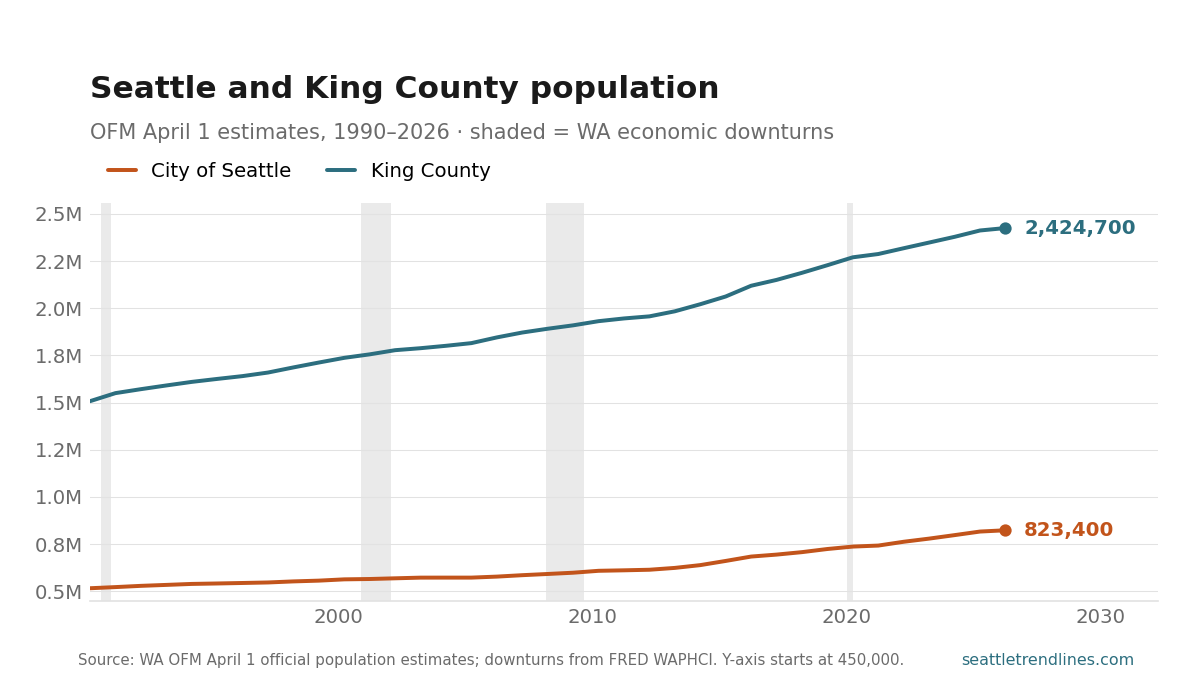
On Washington’s new April 1 estimates, the City of Seattle reached 823,400 in 2026 — up 6,800, or 0.8%, from 2025. King County reached 2,424,700, up 13,000, or 0.5%. Both grew, but the striking part is the deceleration: last year the city added 18,900 (2.4%) and the county 33,600 (1.4%), so 2026’s gains are roughly a third of the prior year’s pace.
For Seattle, 0.8% is the smallest annual gain since 2021, the pandemic-dented low. For King County, 0.5% is the weakest in over a decade — slower even than 2021. The county’s growth has stair-stepped down for three straight years while the city held near 2.4%; this is the first year the city has clearly joined it.
The long view is unchanged. Since 1990 the city has grown 60% and the county 61% — still nearly in lockstep, which is why Seattle’s share of King County has barely moved, from 34.3% to 34.0%. One soft year doesn’t bend a 36-year line. Whether it’s the start of a plateau or a one-year pause is the thing to watch in the 2027 estimate.
Source: WA Office of Financial Management, April 1 official population estimates (state, county and city, 1990 to present). Shaded bands: Washington economic downturns (peak-to-trough in the Philadelphia Fed Coincident Index for WA, FRED: WAPHCI). Annual; OFM releases the next April 1 estimate in late June 2027.