Lake Washington sockeye: the run that no longer runs
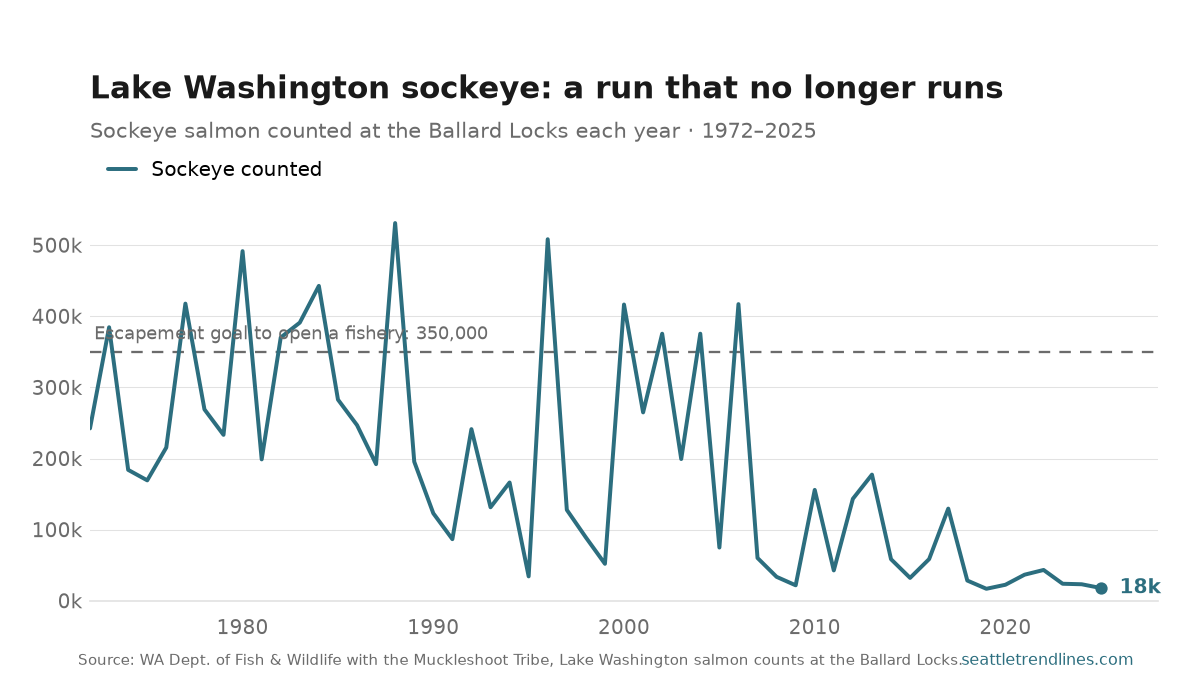
Every summer since 1972, biologists have stood at the Hiram M. Chittenden Locks — the Ballard Locks — and counted sockeye salmon one by one as they leave saltwater and climb the fish ladder toward Lake Washington. It is one of Seattle’s great free spectacles, and one of its longest-running civic data series. In 2025 the count came to 17,881 fish. In 1988 it was 531,063.
That is the whole story in two numbers, but the shape between them matters. For three decades the run was volatile but healthy, regularly swinging between 200,000 and half a million fish; the counts crossed 350,000 — the escapement threshold that has to be met before any surplus can be fished — in a dozen different years. Then, after a last big return of about 417,000 in 2006, the line steps down and stays down. The run has not reached the 350,000 goal since 2006, and the lake’s once-beloved summer sockeye fishery, which drew thousands of boats to Lake Washington in good years, has stayed closed ever since. The typical run since 2007 has been around 37,000 fish — roughly a fifth of the long-run norm.
Fisheries scientists point to a convergence of pressures rather than a single villain: lethally warm water in the Lake Washington Ship Canal that kills adult sockeye before they can spawn, disease that thrives in that warm water, poor survival in a changing ocean, and predation. A hatchery on the Cedar River was built to prop the run up, and hasn’t reversed it. The 2026 count is being tallied at the ladder as this posts — early numbers, still subject to WDFW review, point to another thin year. A run that was once big enough to fish is now watched mainly to see whether it holds on at all.
Source: Washington Department of Fish & Wildlife, Lake Washington salmon counts, conducted with the Muckleshoot Indian Tribe at the Ballard Locks. Sockeye are counted daily from June 12 through July; the annual totals shown here run 1972–2025. The 350,000 line is the escapement goal that must be met to open a fishery. Updated each summer.