Seattle’s cruise business: from a 2020 shutdown to a record 1.9 million
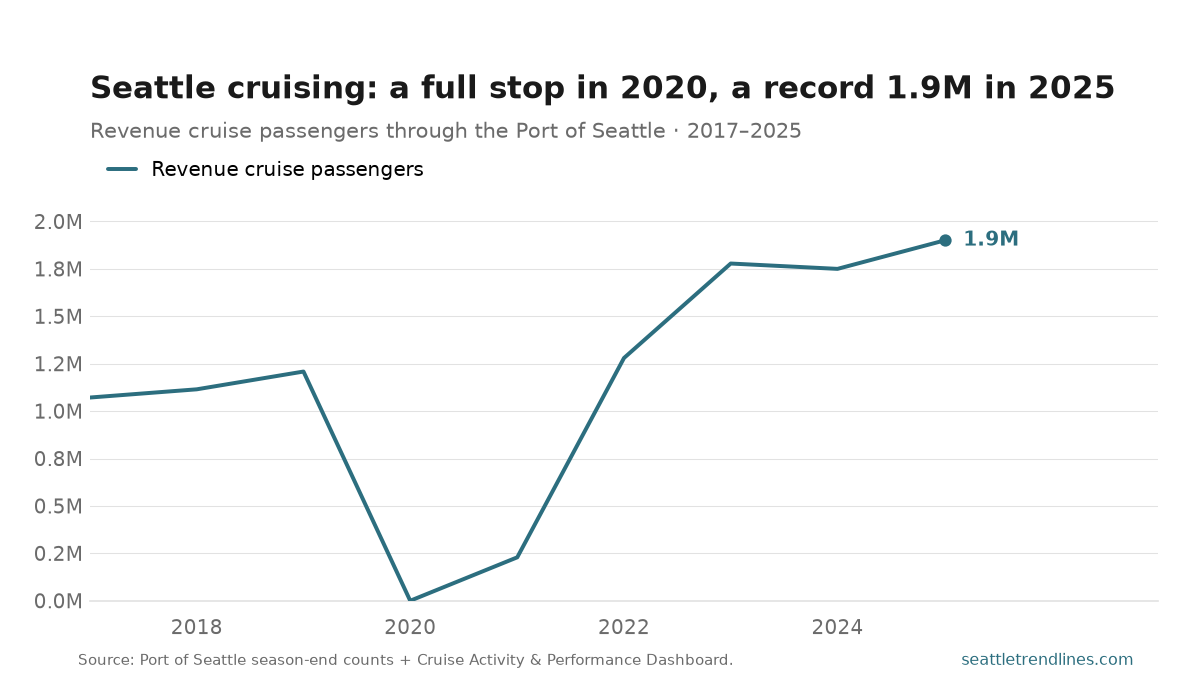
Seattle is the busiest home port for Alaska cruising in the country, and its passenger count is one of the most dramatic V’s you’ll find in any local time series. The Port crossed one million revenue passengers for the first time in 2017 and hit 1.21 million in 2019. Then, in 2020, the season simply didn’t happen — the pandemic cancelled every sailing, and the count went to zero for the first time since scheduled cruising began in 2000. A partial, delayed 2021 season carried about 229,000.
What happened next is the part worth dwelling on: the recovery wasn’t slow. By 2022 — the first normal season back — passenger volume was already at 1.28 million, above the 2019 peak. It has climbed every year since, to 1.78 million in 2023 and a record 1.9 million in 2025, roughly 57% above the pre-pandemic high. Set that against the parts of the Seattle economy still grinding back toward 2019 — downtown office occupancy, transit ridership — and the cruise terminals stand out as the rare sector that didn’t just recover but blew past its old ceiling.
Two caveats keep the number honest. “Revenue passengers” counts each traveler twice — once embarking, once disembarking — so the 1.9 million represents roughly 950,000 individual people (in 2023, 1.78 million revenue passengers were 907,572 individuals). And nearly all of it is packed into a six-month April-to-October season, which is why the working waterfront, the hotels, and Sea-Tac feel it so sharply in summer and not at all in winter. The Port pegs the annual economic impact at about $1.2 billion. From a standing start of six ships and 6,000 passengers in 1999, that’s a quarter-century climb interrupted by exactly one very bad year.
Source: Port of Seattle, season-end cruise counts and Cruise Activity & Performance Dashboard. Figures are revenue passengers (embarking + disembarking) per season; some years are the Port’s officially reported/rounded totals. 2020 = 0 (season cancelled for COVID-19). Updated each fall at season’s end.